


1960s: The Flyby
Verification. Can we see it?
Proving that a spacecraft can survive the journey to Mars and take a photo of the planet.

1970s: The Orbiter + Lander
Observation. What's it like on the ground?
Landing in one spot (Project Viking) to see if the environment is hospitable and if life is visible.

1990s: The Pathfinder
Capability. Can we move around without it costing too much?
Proving a low-cost, mobile rover can survive and diverse teams can build it rapidly under constraints.
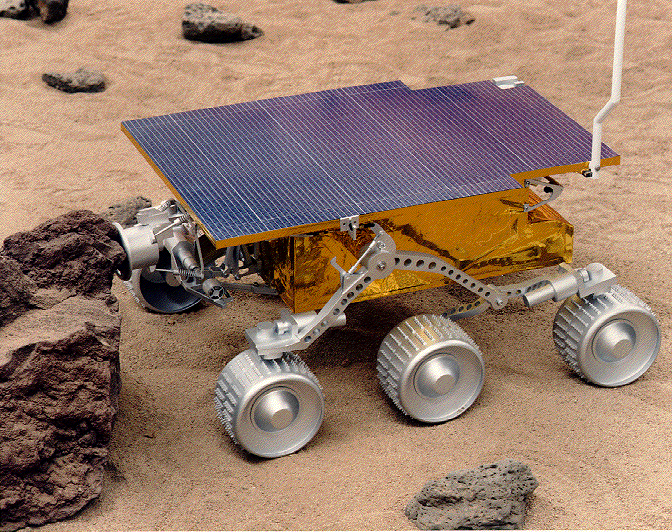
2000 - 2010s: The Rovers
Exploration. Was there ever water or life?
Sustained, long-term robotic presence to map the planet’s history and "follow the water."

2012 - now: The Laboratory
Science Integration. Can we find the building blocks for life?
Using high-complexity mobile labs (Curiosity + Perseverance) to conduct deep chemistry and prepare for human arrival.

Feeling the Pressure
01
Background
In the early 1990s, NASA was facing a crisis of confidence. Previous missions were expensive and took a decade to develop. The usual way of operating had become deeply entrenched. Specialised disciplines like propulsion, navigation, and science, functioned as distinct centres of excellence.
02
Defining the problem
Each team would perfect their component and then engage in a formal handoff, essentially passing their completed work to the next group in the chain. This linear process ensured high technical standards but slowed down the mission (8-10 years), and made it much more expensive and rigid.
03
Faster, better, cheaper
For the Mars Pathfinder mission, this model was intentionally dismantled. NASA was tasked with delivering an integrated flight system consisting of a cruise vehicle, a stationary lander, and the first-ever mobile rover, Sojourner.
04
Shifting behaviour
This required a "Design-Build-Fly" approach that collapsed the traditional boundaries between those who built the hardware and those who operated it. To achieve this, NASA assembled a small, cross-functional team and co-located them in a single workspace for around three years.
05
Mindset shift one
Because the budget was so thin and the schedule so aggressive, a delay in one area immediately stalled everyone else. Scientists, software architects, and mechanical engineers were compelled to engage in constant, real-time dialogue. If the software team needed to update the landing code, they couldn’t wait for a formal report, they would engage with the hardware team directly.
Use highly collaborative behaviours.
06
Mindset shift two
This environment presented a significant shift for the subject matter experts involved. Used to a structure that prioritised deep, undisturbed focus, they were now asked to work in a way that felt much more exposed. Instead of presenting a polished, finalised handoff, experts had to share half-finished ideas and early-stage problems. This required a challenging transition from being the sole authority in a field to being a contributor within a fast-moving, noisy system.
Share and test early.
07
Tools and spaces
This sparked initial friction, as constant interruptions and real-time trade-offs could feel like a distraction from the technical depth people were used to. To overcome this, the team moved beyond talking and into early, shared testing. By building test-beds where the software, sensors, and rover motors were plugged together months earlier than usual, the friction shifted from interpersonal to technical. When a software expert saw their code fail because of a hardware quirk they hadn't considered, the interruption from the hardware engineer was no longer seen as a distraction, but as a critical save and viewed as shared wins in the lab.
08
Results that speak volumes
Success no longer depended on how perfect a component was in a vacuum but on how early it could be integrated into the whole. Pathfinder landed on July 4, 1997. It was the first time a rover had moved on the surface of another planet, and it was built for a fraction of the cost of its predecessors, within a third of the time.
